

Dundalk Driving Test Routes: 5 Spots Where Learners Fail
Dundalk driving test routes look easy on paper. A small town, quiet roads, a test centre on the edge of town: what could go wrong? That is exactly the trap. Most learners fail on Dundalk driving test routes not because the driving is hard, but because the roads feel calm and they switch off: a mirror check skipped on a quiet street, a rolling stop in an estate, the wrong lane at a roundabout, or driving too slowly on a fast road.
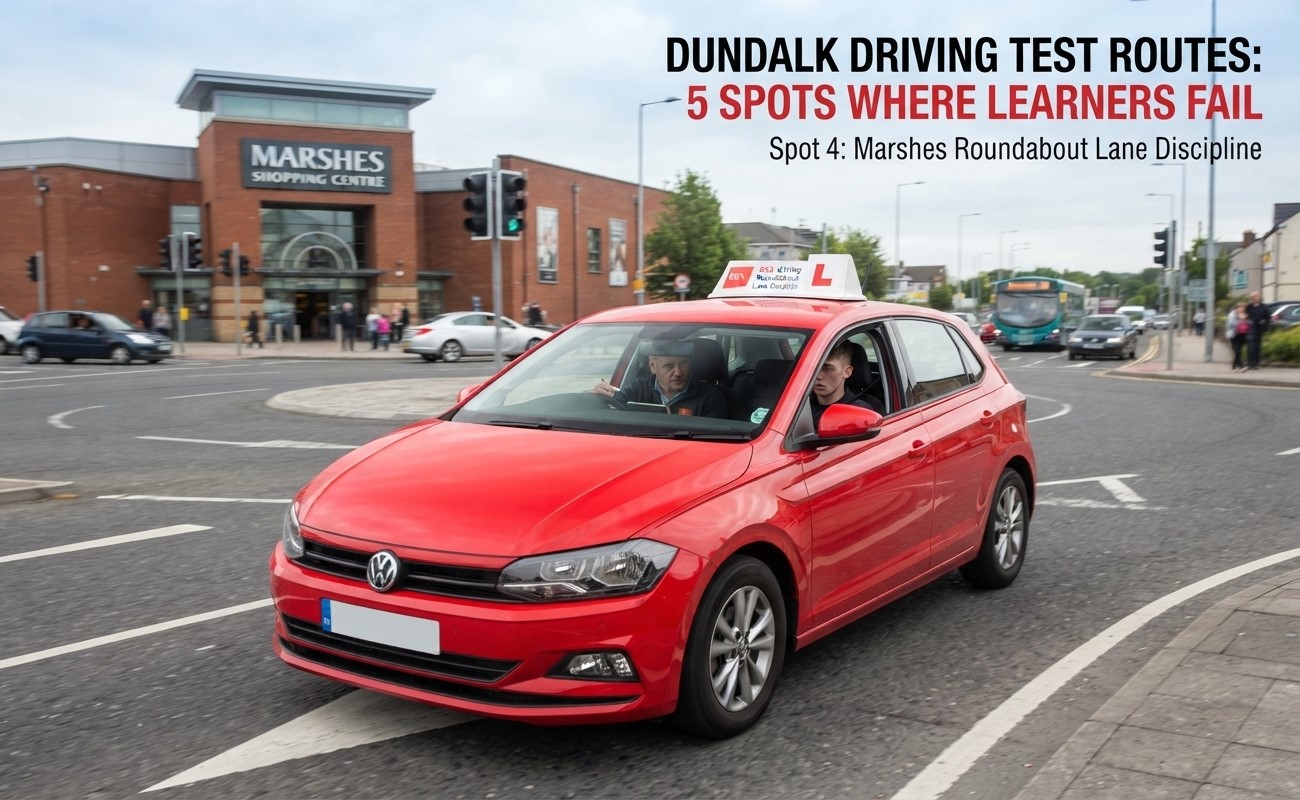 This guide names the five spots where that happens, the mistake at each one, and how to practise it before your test.
The short answer: The five spots on Dundalk driving test routes where learners fail most are the Newry Road start (observation), Racecourse Road (parked cars and road position), the Inner Relief Road roundabout (lane choice), the housing estates (rolling junctions), and the N52 speed changes (too slow or too fast).
Practise them on Dundalk driving test routes before test day, with a pretest lesson on the same roads, and you remove the surprises that fail most Dundalk candidates.
What to know first: the centre, the test, and the routes
The Dundalk driving test routes start at the RSA test centre on the Newry Road in Lisdoo, Dundalk, Co. Louth, A91 RY8X, the RSA’s own complex, opened in January 2020, beside the Aldi store on the north side of town. The test itself runs 30–40 minutes on the road, at least 7.5 km, plus Rules of the Road questions and technical checks at the start. You may be asked for a reverse around a corner, a turnabout, a hill start, and parking manoeuvres. The test fee is €85 for a car.
The numbers are on your side, just. On Dundalk driving test routes, 54.9% of Category B tests were passed (CSO/RSA statistics, September 2026), above the 52.2% national average and the wait for a test invitation is around 11 weeks, so a fail costs you months, not days.
One honest note before the spots. The RSA does not publish Dundalk driving test routes, and the examiner chooses one on the day so nobody can sell you “the official route,” and any page that claims to is guessing. What this guide gives you is better: the roads commonly used, named by name, and the exact fail at each. Drive them with your instructor until they are routine.
Spot 1: The Newry Road start observation on quiet roads
The first minutes of Dundalk driving test routes set the tone, and the trap is the quiet. It is the quietest stretch of Dundalk’s driving test routes and the most deceptive. The centre sits on the Newry Road (the R132), a two-lane 50 km/h road with a cycle lane, traffic lights, and pedestrian crossings by Aldi and the filling stations. Because traffic is lighter here, examiners watch observation harder, not less: mirror checks, visible head movement, and awareness of what is around you.
The mistake: moving off and turning without a proper mirror and blind-spot check, because the road looked empty. Observation is the RSA’s most common failure reason in Ireland, and Dundalk driving test routes are where it bites quietest.
How to practise: on every lesson, narrate your checks out loud, mirror, signal, and blind spot before every move-off and turn, and make your head movement visible. Ask your instructor to drive the Newry Road and start in silence and count your checks; if they cannot see them, the examiner cannot either.
Spot 2: Racecourse Road parked cars and road position
From the centre, Dundalk driving test routes typically turn onto Racecourse Road roughly 750 metres of parked cars on both sides, narrow gaps, and oncoming traffic that expects you to give way cleanly. Racecourse Road is one of the narrowest stretches on Dundalk driving test routes, and it is where road position faults pile up: drifting towards the kerb, swinging too wide past parked cars, or stopping too far back. Racecourse Road rewards the learners who treat every parked car on Dundalk driving test routes as a hazard.
The mistake: treating parked cars as scenery instead of a hazard. The examiner wants early mirror checks, a clear signal before moving out, and a return to the correct position without hesitation. Parked cars on Dundalk driving test routes force that sequence again and again and learners who rush it collect Grade 2 faults under road position.
How to practise: drive Racecourse Road with your instructor and rehearse the sequence at every parked car: mirror, signal, move out smoothly, mirror again, move back in. If you cannot pass a parked car without a wobble, you are not ready for the test; keep practising until the sequence is automatic.
Spot 3: The Inner Relief Road roundabout lane choice
The Inner Relief Road roundabout is the best-known hazard on Dundalk driving test routes. It is the roundabout every learner on Dundalk driving test routes remembers. It is a multi-lane roundabout with fast traffic, where the N52 (Coe’s Road and the Táin Bridge) carries traffic at 60 to 100 km/h. Lane choice on Dundalk driving test routes roundabouts is the decision the examiner watches most closely here: the wrong lane on approach, a missing exit signal, or hesitation when there is a clear gap.
The mistake: choosing the lane late, or choosing it for the exit you want rather than the lane the markings require then drifting across lanes on the roundabout itself.
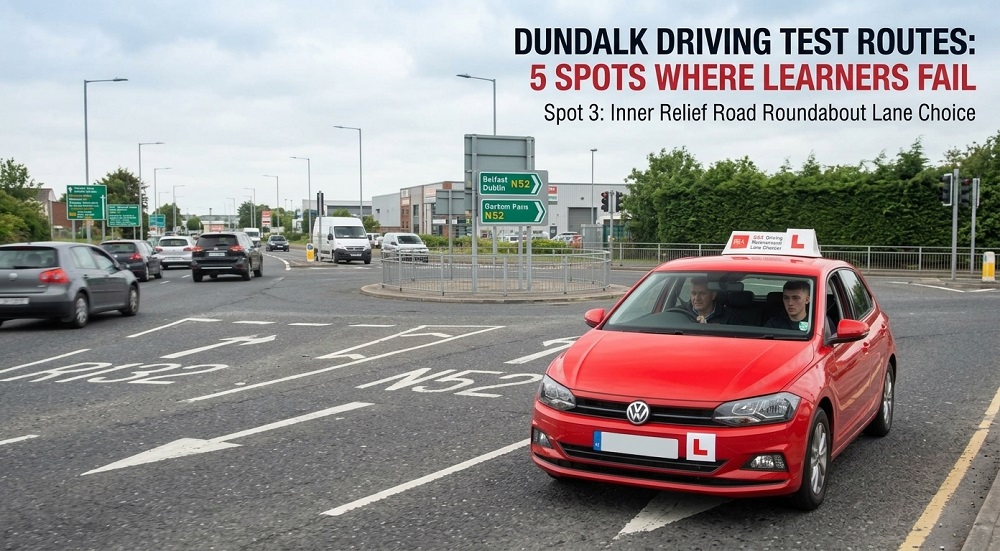 How to practise: approach every roundabout on your lessons with the same routine: read the signs and road markings early, pick your lane before the roundabout, signal your exit, and go when the gap is safe — do not sit and wait for a perfect gap. Drive the Inner Relief Road roundabout several times with your instructor, from each approach, until lane choice is a decision you make early.
Spot 4: The housing estates’ rolling junctions
Housing estates appear on most Dundalk driving test routes: Lismullen Grove, Racecourse Meadows, and Dowdall Crescent near the center, and estates off the Dublin Road and they are where learners fail quietly. Tight streets, parked cars, speed ramps, and poor visibility: the estates on Dundalk driving test routes demand very low speed and clear left–right checks at every junction. The estates are the least dramatic spot on Dundalk driving test routes and one of the most common fail points.
The mistake: rolling through estate junctions. Learners slow down, look once, and roll through without a proper stop or a full check or they stop too far back and creep forward without checking again. In an estate, that is a fail: the examiner reads it as inadequate observation at a junction, the RSA’s top fail category.
How to practise: drive the estates at a walking pace with your instructor and stop properly at every junction, even when it looks empty. Practise the full routine slowly, check left, check right, check left again, then go until it feels slow and boring. Boring is what passes in an estate.
Spot 5: The N52 speed changes too slow, too fast
Speed control is one of the biggest failure reasons on Dundalk driving test routes, and the N52 is where it happens. The N52 is the fastest stretch of Dundalk driving test routes and the one that punishes inattention. The N52 section of Dundalk driving test routes moves you from the Inner Relief Road into 60 and 100 km/h stretches, and learners fail in both directions: driving too slowly because they are nervous or missing a sign and drifting over the limit.
The examiner wants appropriate speed, not caution overload staying too slow is a progress fault, and it is marked. Speed is the one fail on Dundalk driving test routes that has nothing to do with skill and everything to do with attention.
The mistake: dropping speed unnecessarily or not reaching the limit when it is safe. Learners who have spent weeks driving at 30 and 50 km/h in town often cannot believe the N52 allows 100, so they sit at 60 and hold up traffic or they miss the sign entirely and carry town speed onto a fast road.
How to practise: on every lesson, call out the speed limit as you pass each sign, and match it promptly. Ask your instructor to drive the N52 stretch with you and practise the transitions: 50 to 60 to 100, and back down again. If you can read the signs, say the limit and reach it smoothly, this spot stops being a fail point.
How to practise the 5 spots before test day
A pretest lesson on Dundalk driving test routes should cover all five spots in one drive, not as a route to memorise, but as a rehearsal of the decisions at each. A mock test on Dundalk driving test routes does the same under test conditions: your instructor plays the examiner, marks the faults, and tells you which spot needs work. DriveWave’s pretest driving lessons in Dundalk and mock driving tests both run on these roads. If you are nervous, read our guide to overcoming driving anxiety first.
Two rules: never practise by memorising a route the examiner chooses on the day and practise the spots until they are boring. The learner who passes is not the one who drove the route; it is the one who checked the mirror, chose the lane, and read the sign the same way for the fiftieth time.
Conclusion
The five spots above are the Dundalk driving test routes in miniature: a quiet start that punishes skipped checks, a narrow road that punishes bad position, a fast roundabout that punishes late decisions, estates that punish rolling junctions, and a fast road that punishes the wrong speed.
Practise Dundalk driving test routes with an instructor who knows these roads, take a pretest lesson or a mock test on them, and walk into the centre on test day having already driven your worst moments fifty times. Book a pretest lesson in Dundalk or call DriveWave on 085 719 3433 and if you want the full picture first, read our Dundalk driving test centre guide and our guide to how to pass your Dundalk test first time.
Frequently Asked Questions
What are the Dundalk driving test routes?
Dundalk driving test routes are the roads commonly used by RSA examiners from the Dundalk test centre on the Newry Road, Racecourse Road, the Inner Relief Road, the N52, and nearby housing estates. The RSA does not publish exact routes, and the examiner chooses one on the day.
Where is the Dundalk driving test centre?
The RSA test centre is on the Newry Road in Lisdoo, Dundalk, Co. Louth, A91 RY8X the RSA complex beside the Aldi store on the north side of town. Arrive early and check your MyRoadSafety confirmation.
What is the Dundalk driving test pass rate?
54.9% of Category B tests were passed in Dundalk (CSO/RSA, September 2026), above the 52.2% national average. The wait for a test invitation is around 11 weeks, so a fail costs months which is why practising the five fail spots matters.
Do Dundalk driving test routes include roundabouts?
Yes. The Inner Relief Road multi-lane roundabout is one of the best-known hazards, and smaller roundabouts appear throughout the routes. Wrong lane choice on approach, missing exit signals, and hesitation with a clear gap are the most common roundabout faults.
How long is the driving test in Dundalk?
The drive takes 30–40 minutes and covers at least 7.5 km, plus questions and technical checks at the start. Allow about an hour in total.
What manoeuvres are on Dundalk driving test routes?
You may be asked for a reverse around a corner, a turnabout, a hill start, and parking manoeuvres. Practise each in quiet streets and car parks before your test.
How much does the driving test cost in Ireland?
The car driving test costs €85. You also need a valid learner permit, and from 9 March 2026 you must produce a valid certificate of motor insurance showing you are insured to drive the test vehicle.
Can I practise Dundalk driving test routes before my test?
Yes. Drive the roads with your instructor or sponsor, and take a pretest lesson or mock test on the same roads that is the most useful preparation. Do not try to memorise a route: the examiner chooses one on the day, so practise the decisions, not the turns.
What should I bring to the Dundalk driving test?
Your valid learner permit, your test appointment confirmation, and the insurance certificate for the test vehicle (required since 9 March 2026, with an insurer letter if you are not named on the certificate).
Where do learners fail most on Dundalk driving test routes?
The five spots in this guide: Newry Road (observation), Racecourse Road (parked cars), the Inner Relief Road roundabout (lane choice), the estates (rolling junctions), and the N52 (speed).
Are Dundalk driving routes the same for every candidate?
No. The RSA keeps exact test routes private, and the examiner chooses one on the day, so routes vary. The roads and junctions in this guide are the ones commonly used learn the decisions at each spot, not a fixed route.
How long is the wait for a driving test in Dundalk?
Around 11 weeks to a test invitation (CSO month-end figure). Book early through MyRoadSafety, and use the wait for pretest lessons on the test roads.
Can I do the driving test in an automatic car in Dundalk?
Yes. Pass in an automatic and your licence carries Code 78, restricting you to automatics only; pass in a manual and you may drive both. DriveWave teaches both, at the same prices.
What happens if I fail on Dundalk driving test routes?
You receive a fault report showing exactly where you lost marks, usually one of the five spots in this guide. Fix that spot with a pretest lesson, then rebook through MyRoadSafety. Read our guide on what to do after failing your test in Dundalk for the full process.
Do I need a pretest lesson for the Dundalk test?
It is not required by the RSA, but it is the most useful preparation: a pretest lesson drives the same roads as your test and corrects your weak spots before the examiner sees them. Most learners who fail do so on faults a single pretest would have caught.
What speed limits are on Dundalk driving test routes?
Town centre streets are 30 km/h in places, the Newry Road is 50 km/h, and the N52 runs at 60 to 100 km/h. Missing a sign or staying too slow after the limit rises is one of the most common Dundalk fail reasons.